
How can psychology inform real efforts to improve sustainability within large organisations? A recent curriculum design initiative in the undergraduate BSc Psychology programme set out to address this question directly. ‘Psychology for Sustainability’ is a new final-year optional unit taught by Dr Paul Bain and Dr Steve Westlake that explores how psychological research and theory can help understand and address sustainability issues.
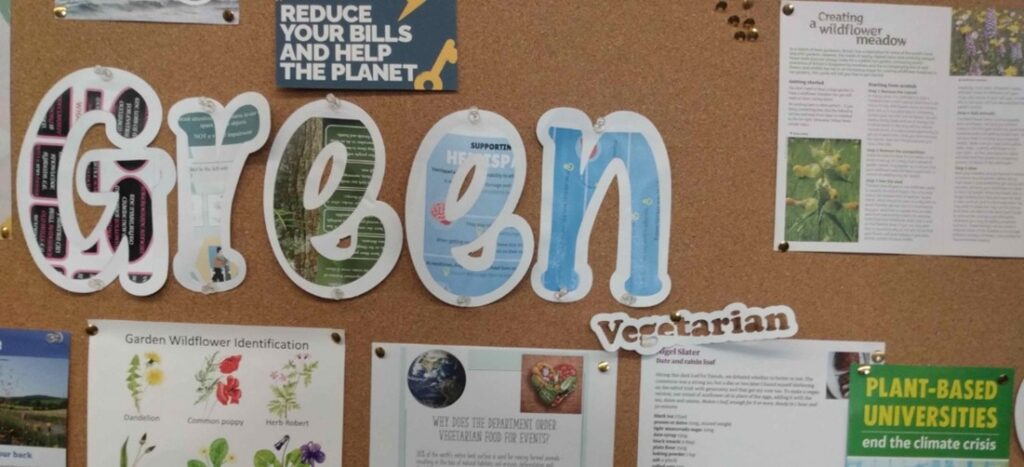
A central feature of the unit is an applied assessment in which students provide evidence-based recommendations to improve a real organisational sustainability initiative. In this case, students worked with the University of Bath’s Green Impact staff sustainability engagement programme, which supports teams across the University to take practical actions that reduce environmental impact and embed more sustainable working practices. With support from Green Impact lead Georgia-Rose Gleeson, students analysed the programme through their disciplinary lens, developing recommendations grounded in psychological theory and research.
While the theories covered in the unit are applicable to many sustainability challenges, focusing on a specific programme within their own University required students to consider how psychological approaches operate in practice. This enabled them to think about psychology and sustainability not only in abstract terms, but in relation to potential real-world sustainability impacts.
Moving from sustainability awareness to evidence-based action
A key aim of the unit was to give students experience in applying psychological theories and research findings to a real sustainability programme. In doing so, the unit also aimed to develop students’ understanding of both the strengths and limitations of psychological approaches, and how these approaches interact with other academic disciplines and social systems when working towards desirable social change.
As students chose to take this optional unit, most were already aware of sustainability issues. However, for many it was the first time they had been required to think through how they would use their psychology training in practice to increase sustainable behaviours. This included considering the beliefs, preferences and constraints of their intended audience (in this case, the programme participants and Green Impact managers). The teaching team hoped that this experience would help students become more effective advocates for sustainability in their future professional lives.
Published on: 26/03/2026 · Last updated on: 26/03/2026
Designing teaching and assessment around real-world sustainability consultancy
Most classes were structured in two parts: an initial focus on psychological theories and research, followed by group discussions exploring how these ideas could be applied — or might be limited — in the context of Green Impact. This structure reinforced the unit’s applied focus and encouraged students to move repeatedly between theory and practice.
For formative assessment, student groups developed a short “pitch” presentation, delivered in person to academic staff and Green Impact representatives for feedback. This created a low-risk opportunity for students to test their ideas, refine their recommendations, and gain experience presenting to real professional stakeholders.
The summative assessment took the form of a consulting report. Students were required to communicate evidence-based recommendations clearly and practically, focusing on achievable sustainability improvements. The task was designed to develop skills in effective communication about sustainability, alongside critical thinking about how psychological ideas can be translated into practical actions.
In line with the sustainability focus of the unit, use of generative AI was discouraged in assignments due to concerns around its environmental implications, including high energy and freshwater use. The sustainability impacts of AI were discussed explicitly with students as part of this decision.
Evidencing student engagement through real-world consultancy outputs
The unit and assessment were deliberately challenging, requiring students to think beyond the traditional boundaries of a psychology-focused degree and to consider psychology within wider disciplinary and organisational systems. Most students responded well to this challenge. In particular, the high quality of the formative “pitch” presentations to academic staff and Green Impact representatives — despite not contributing to their mark — indicated strong engagement with the task.
Students were encouraged to structure their consulting reports in ways they felt would most effectively communicate their recommendations to the client. Many embraced this opportunity, using formatting, structure, images and visual elements to produce clear and engaging reports.
With students’ permission, a selection of the strongest reports was forwarded to Green Impact for possible implementation or adaptation. These reports are currently under review. Reports identified as particularly useful will be recognised with a letter of appreciation from Green Impact, providing students with evidence of producing valuable work for a real organisational client.
Reflecting on the benefits and limits of “close to home” sustainability learning
This was the first year the unit was delivered, creating an opportunity to develop the curriculum and assessment approach from scratch, but also involving a degree of uncertainty for both students and the teaching team.
One strength was integrating psychology teaching with an assessment that was “close to home”: supporting a sustainability programme operating within the students’ own university, where they already had some organisational experience and understanding. This helped students engage more meaningfully with the wider factors that influence change, including organisational culture, relationships to technology, workload, and other contextual considerations alongside the psychological factors at the core of the unit.
At the same time, asking students to develop realistic recommendations for an existing programme may have limited the extent to which they engaged critically with the broader institutional, social and political constraints shaping such initiatives. The focus on improving Green Impact may have made it more difficult to propose more transformational alternatives (for example, questioning whether a fundamentally different approach might be required), and the group-based nature of the assessment may have reduced opportunities for more radical perspectives to emerge. In future iterations, the teaching team will consider how the assessment might more explicitly create space for critical and transformational thinking alongside practical recommendations.