
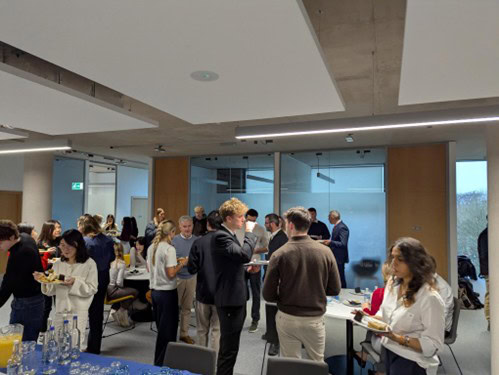
At a time when sustainability challenges are at the forefront of global concern, collaboration between education and business is increasingly important. The Company Consultancy Project, a core applied unit within the MSc Sustainability and Management programme delivered by Dr Kostas Iatridis and Dr Gabriela Miranda, was developed in response to a growing need for well-rounded sustainability professionals — graduates who can combine theoretical understanding with practical, analytical and interpersonal skills to address complex sustainability challenges in real organisational settings. The unit’s delivery is supported by the School of Management MSc Careers Service, who broker relationships with suitable partner organisations.
As sustainability becomes a strategic priority across all sectors, employers increasingly seek graduates who can critically assess current practices, work collaboratively with stakeholders, navigate organisational constraints, and design feasible, evidence‑based solutions. This unit goes beyond traditional classroom learning alone, pairing students with organisations on a live project, helping prepare them for the messy, interconnected nature of real‑world sustainability issues. The unit nurtures graduates who are better equipped to drive sustainability initiatives in their future careers and consistently provides value for both students and partner organisations.
From theoretical knowledge to applied sustainability competencies
The unit deepens students’ understanding of sustainability as a complex, real-world challenge and emphasises the value of practice-based learning in addressing it. Students build on their theoretical knowledge while developing the confidence and capability to analyse sustainability issues through direct organisational engagement. Through authentic learning, students cultivate key competencies expected of sustainability professionals: systematic analysis of sustainability challenges, critical evaluation of corporate initiatives and their credibility, and recognition of the constraints and trade-offs involved in implementing sustainable practices. By embedding authentic learning within the MSc Sustainability and Management programme, the unit prepares students to navigate and influence sustainability efforts in their professional careers.
Published on: 26/03/2026 · Last updated on: 26/03/2026
Designing learning around real organisational sustainability challenges
The Company Consultancy Project places students in small consultancy teams to work directly with a range of clients. Students assess their client’s current sustainability practices, benchmark performance against industry standards, and develop evidence-based recommendations to strengthen sustainability performance. The structure of the unit intentionally mirrors competencies required in sustainability practice: critical analysis, stakeholder engagement, systems thinking, practical problem-solving, adaptability and the ability to navigate organisational complexity.
In class, students use professional tools and frameworks such as materiality assessments, stakeholder mapping and gap analysis to build applied competencies. Discussions and reflective activities focus not only on what organisations do, but why sustainability initiatives succeed or encounter resistance. Guest lectures from experienced sustainability practitioners further expose students to the realities of implementation, including resource constraints, competing priorities and stakeholder pressures. Across these activities, sustainability shapes both the content and the method of learning by emphasising authentic, collaborative and systems-oriented approaches.
Strengthening students’ confidence and professional judgement through authentic learning
The authentic approach has had a positive impact on student learning and engagement. Working with real organisations has strengthened students’ ability to apply theoretical concepts to practical sustainability challenges and has led to more confident and critical analysis of organisational practices. Students demonstrate improved problem-solving, stakeholder communication and professional judgement after the consultancy experience. In addition, the experience helps students clarify both the skills and sustainability areas they may want to pursue, enabling them to enter the workforce with clearer career direction. Future development of the unit will focus on strengthening student support and expanding the range of sustainability contexts students encounter, building on the success of the authentic model.