
Published on: 25/04/2025 · Last updated on: 23/01/2026
Introduction
Generative Artificial Intelligence (see our article overviewing GenAI and the green note below) presents both opportunities and challenges for those working in education. To support staff we have prepared this list of FAQs. Parallel guidance, issued for students, has been produced by the Skills Centre. For guidance on using AI in research, please click here.
Note: although this guidance is informed by existing legal frameworks, it does not in itself constitute legal advice and the situation is constantly evolving.
Ethical issues with GenAI
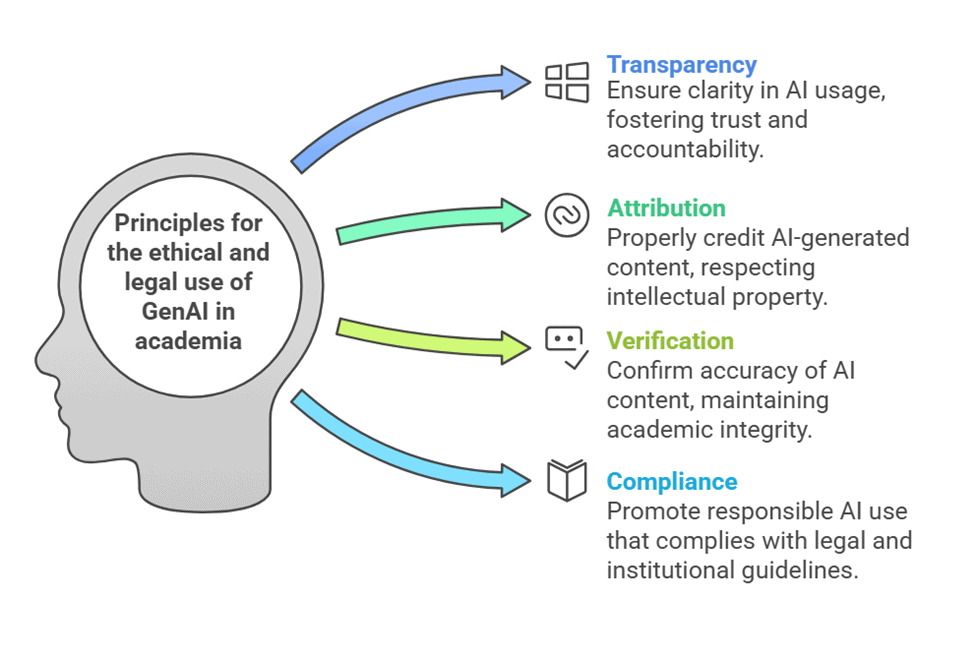
While many staff and students at the University of Bath recognise the opportunities GenAI presents, such as reducing administrative burdens, providing opportunities for more personalised learning, and acting as a critical friend, there are legitimate concerns that it is important to be aware of and sensitive to. These concerns primarily relate to data protection risks, epistemic challenges, and issues of sustainability and social justice. Colleagues across the sector, have expressed concerns around the use of GenAI, detailing some of these in an open letter in July 2025.
The University seeks to actively address the concerns colleagues raise through measures such as advocating for judicious tool selection, thoughtful pedagogical design, critical use of GenAI by staff and students, and by providing access to Microsoft Copilot with appropriate data safeguards. However, these are complex, systemic issues without straightforward solutions. They require particular attention when designing Type C assessments, which involve student engagement with GenAI. Click below to read more.
| Breaches of and risks to data protection |  | Privacy | GenAI is such new technology that there is very little oversight or regulation as regards the operation of GenAI tools. One study that UCL were involved with found evidence of AI browser assistants gathering and sharing user data ‘without transparency or consent and sometimes in breach of privacy legislation or the company’s own terms of service’. These concerns can be addressed through appropriate tool selection. At Bath our supported tool is Microsoft Copilot. If used when logged in to your university account, this tool safeguards user data, though you should never share confidential or commercially sensitive data with AI. |
 | Breaches of copyright | AI models are trained on vast amounts of data, and many companies did not seek permission to scrape this data from the copyright holder. Legal systems around the world are attempting to strike the right balance between the rights of copyright holders, GenAI companies’ desire to innovate, and the need for transparency around the source and accuracy of information. Discussions are ongoing. For more information see Jisc’s introduction to copyright and GenAI. | |
| Epistemic challenges |  | Pedagogical concerns | Concerns have been raised that GenAI may harm learning by replacing cognitive effort. For example, a 2025 brain-scan study by MIT’s Media Lab concluded that those using ChatGPT for essay writing, built up a ‘cognitive debt, a condition in which repeated reliance on external systems like LLMs replaces the effortful cognitive processes required for independent thinking’ (p. 141) – although they noted that a larger sample size was needed to confirm the finding. Others have stressed the need to interpret the paper with caution. |
 | Creating misinformation and disinformation | GenAI’s ability to create video and audio that mimics the real world can be harnessed by bad actors to spread disinformation, such as when deep fake audio of Sadiq Khan was released in November 2023. AI generates outputs that appear plausible but may not be factually true, and this plausibility may lead to the inadvertent propagation of misinformation; although there is also evidence that dialogue LLMs can help reduce conspiracy beliefs. | |
| Sustainability concerns |  | Excessive use of energy | Over its lifetime GenAI uses a significant amount of power. This can be divided into ‘embodied’ energy in terms of hardware, building infrastructure, transportation etc, and ‘operational’ energy that is used during the training and use of the model. Image generation is the most energy-hungry use of AI. Further information can be found here. |
 | AI Model Collapse | AI models are often trained on data that is found online. As greater amounts of this training data is generated by AI itself research shows that errors are compounded and the LLMs develop defects. This is known as AI model collapse and is a significant challenge to the sustainability of the AI industry. There are also questions around the industry’s financial viability. | |
| Issues around social justice |  | Workforce exploitation | GenAI training involves human input, such as data labelling and content moderation. The former is monotonous, while the latter may involve watching traumatic content with inadequate mental health support. This work is often poorly paid and precarious. It has been dubbed a new form of ‘digital colonialism’, as this work is often outsourced to those in the Global South where labour is cheaper and there are fewer protections. |
 | Exacerbating inequality | It can be argued that GenAI exacerbates inequality in two senses. Firstly, GenAI models reflect their often highly biased training data, reproducing those prejudices in response to prompts and thus suppressing minority views and reinforcing stereotypes. Secondly, recent research by HEPI shows certain groups benefiting more than others from GenAI, ‘with male students, students on STEM and Health courses and more socioeconomically advantaged students more likely to use AI’. This ‘digital divide’ is further widened by the existence of premium AI models offering additional features. That said, GenAI can also be harnessed to remove barriers, for example, supporting inclusive teaching and learning through its ready translation of teaching material into multiple formats, which is particularly valuable for those with disabilities. |
Data protection and copyright laws
Important issues to consider when using GenAI are those around data protection and copyright laws. When considering inputting material into GenAI, ask yourself:
‘Do I own the copyright to this material?’
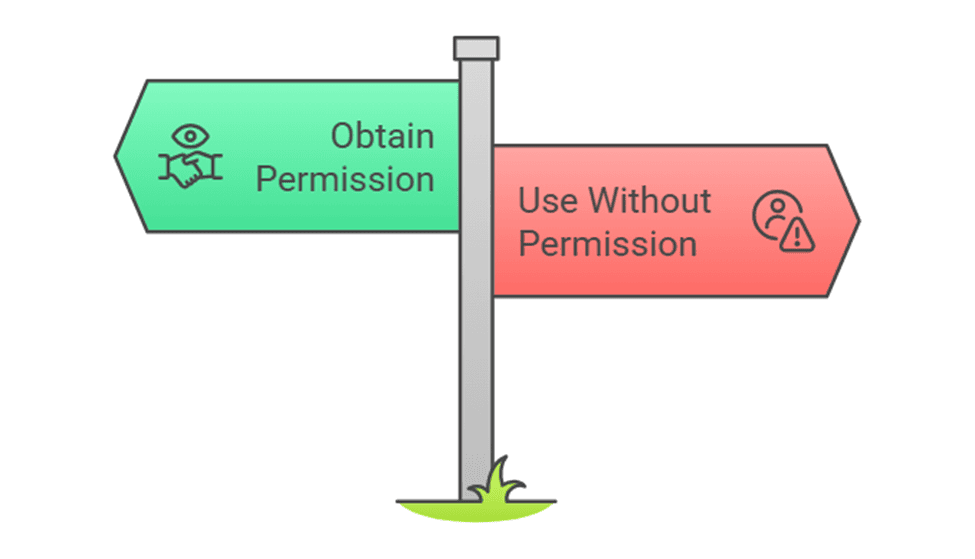
Copyright belongs to the author or creator of original work, whether in writing or an audio-visual medium, unless or until those intellectual property rights are assigned to someone else. Accordingly, in most cases, students own the copyright to their notes and assessments and it would be an infringement of their copyright to copy, share, broadcast or adapt their work without their explicit permission* – all of which arguably occur when inputting students’ work into a GenAI tool.
How does data protection legislation (E.g. GDPR) intersect with GenAI?
It is always important to be aware of the provisions of GDPR. Even where a student has given permission for their work to be inputted into an AI tool, they are still entitled to certain legal protections:
- For their work not to be personally identifiable. This involves more than simply redacting a student’s name. For example, details within the assignment itself may give clues to the student’s identity. You should also be aware that the metadata of files often indicates the author. It may be possible to remove this.
- For their data not to be held indefinitely. When their data is no longer required it should be securely deleted.
Please note: if you are privy to any confidential or commercially sensitive data this should never be shared with AI.
FAQ
Expand a section below for more information