
Published on: 20/09/2023 · Last updated on: 29/10/2026
Introduction
Generative AI refers to artificial intelligence systems that can create new content. This can include:
- Text
- Images
- Audio (Sound effects and music)
- Code
- 3D Models
- Video Clips
- Realistic sounding voices
It is also used to refine and repurpose existing content. For example:
- Summarise a long document by extracting key points
- Create minutes in an agreed format from a meeting audio recording
- Create a written step by step guide from a video text transcript
- Generate an audio ‘podcast’ based on the text content of a document or webpage
Introduction to Generative AI from Google
This introductory video offers a clear, concise introduction to GenAI:
Recent models such as Google’s Veo-3 use a text prompt to generate outputs that combine realistic video, human movement and lip-synced audio.
Text prompt used to generate the clip below: ‘A wide shot of a university lecturer teaching an engaged group of students. She turns to the camera in a close-up and says ‘Need help with your classes? Try the teaching hub for a little support!’. She winks and turns to face her students again. Do not add subtitles or any text to the video. The classroom is bright and modern and colourful’.
Below, AI clone and translation tools were used to translate and ‘revoice’ the first minute of our 2026 systems overview video into French:
Generative AI systems and models are trained on vast datasets and generate outputs which appear novel while being consistent with the patterns found in the training data.
Microsoft Copilot
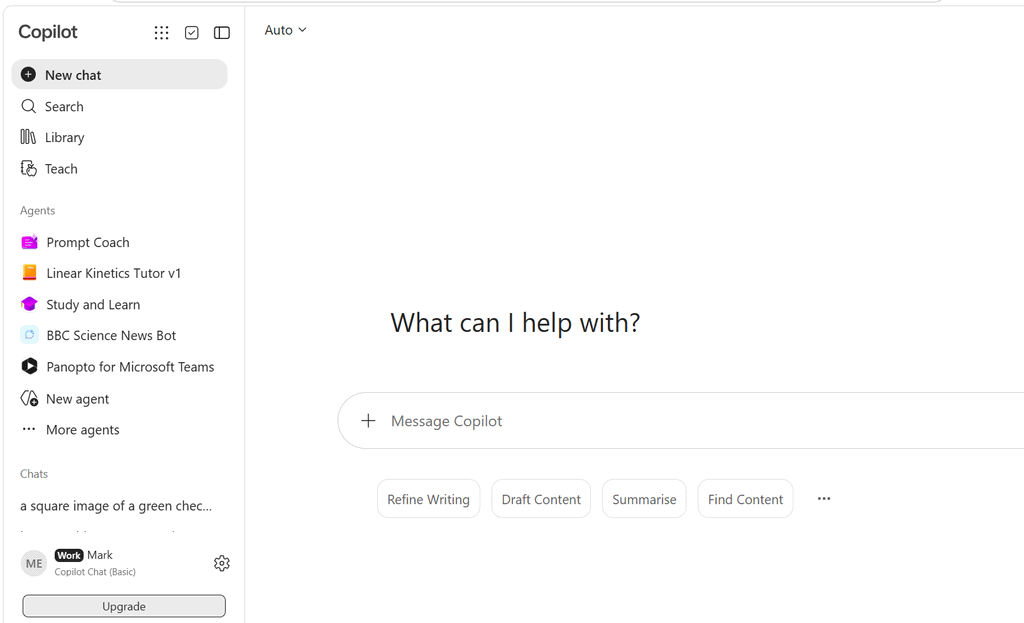
Microsoft Copilot is built into Microsoft Office and can be accessed directly at m65.cloud.microsoft/chat.
It is the only GenAI tool provided by the University of Bath for work use and is made available to all staff and students. Please log into it using your Bath login – The interface will be different for home users and for users who are not logged in. Please see our dedicated Microsoft Copilot page for detailed information and a video walkthrough.
GenAI capabilities and trends
The generative AI ‘gold rush’ has resulted in the rapid rise of improved capabilities and integration with traditional work-based workflows. For example:
- Identifying novel drug candidates
- Generate personalised puzzles and study materials
- Create advertising and marketing materials
Generative AI transforming industries in 2025
What is Artificial Intelligence?
We have all probably interacted with a chatbot of some kind in the last few years – normally they appear as pop-up assistants on websites, responding to frequently asked questions. Some of you may even remember Microsoft’s Clippy (although fear not, the friendly paperclip is back)! In the context of our own homes, Apple’s Siri, Amazon’s Alexa or Google’s Assistant, are all waiting and listening for a wake word in order to help purchase items, play songs, turn on lights or set the kitchen timer.
What these tools have in common is that most are powered by Artificial Intelligence (AI). While not every chatbot is powered by AI – which may go some way to explaining their varying levels of helpfulness as customer service agents – and not everyone feels comfortable welcoming Amazon or Google into their bedroom – AI is increasingly found all around us, not least in many websites and software we use every day. For instance, if you have used the ‘design ideas’ function in PowerPoint, or Microsoft Editor in other Office365 tools, then you will have been using AI to create designs, check spelling and grammar, summarise and improve the accessibility and readability of text and images. Indeed, such software has been available for several years, and is widely used in the workplace in a variety of settings, such as robotics, healthcare and, increasingly, in Higher Education.
AI itself is a contested term, but essentially it is the simulation of human intelligence processes by machines, especially computer systems. Further, when AI is talked about, what is often being referred to is one component of AI – machine learning. Machine learning is a subset of AI that involves the development of algorithms and statistical models that enable computers to learn from data, without being explicitly programmed. The goal of machine learning is to develop models that can make predictions or take actions based on input data.
Machine learning algorithms can be applied to a wide range of problems such as image recognition, natural language processing, predictive analytics, and decision making.
Limitations
While not a contender for the next Booker Prize (yet), ChatGPT is already good enough for students to use in their writing process by providing suggestions for sentences, paragraphs, essay plans, feedback on drafts and even producing entire scripts; it can also generate complex code. As this following resource makes clear, its uses are seemingly endless, and it can be a fairly good German teacher to boot (it claims to be available in 95 languages currently).
This is not to say that ChatGPT is perfect – indeed it has some key known limitations (and like humans, it is not always 100% correct, even if it confidently assumes it is most of the time). Furthermore, and this is something the tool currently does not tell you – in order to ensure its results are not harmful or distressing, the underlying data set is trained. It has been reported that Openai outsourced this to workers in Kenya – paid $2 a hour – to sift out deeply unsavoury content from the darkest parts of the internet, so much so that, in one instance, a worker has been left mentally scarred by what they have viewed.
As a large language model, ChatGPT does not understand the world or connections between the things it says. It may be trained to recall things, but it does not understand them. That is not to say it is telling lies, per se, or is trying to deceive you, but simply it does not know what it is telling you. To be an effective tool in Higher Education, it also requires human beings to best assess its usefulness as a research and writing tool. This is where we, as educators, can step in.
Support with working with GenAI
If you’re new to GenAI and would like to join a beginner-friendly session, Tel run the ‘Introduction to Copilot’ session online throughout the year. This session is suitable for any member of staff. For current availability please see the events page and search for ‘Copilot’.
If you’re already working with GenAI and would like to join a themed practical workshop, please see the events page and search for ‘AI in practice’. We anticipate running three workshops during this academic year.
If you have a specific request for help or guidance, or would like to discuss setting up a tailored session for your department or team, please email tel@bath.ac.uk in the first instance.