
What is Reflective Learning?
Reflective learning is the process of critically examining experience by connecting it with evidence, theory, and feedback to develop understanding, future practice, and enhance self-awareness, and ability to direct ones own learning. Informal reflection is an integral part of learning and teaching, not just in summative assessment.
Reflection moves beyond describing events or actions, it involves questioning assumptions and bridging experience with knowledge to plan future direction.
Why use reflection in your teaching?
You may have read about or encountered reflective frameworks before, such as, The Experiential Learning Cycle, Kolb (1984), or The Reflective Cycle, Gibbs (1988), which are integral to both academic and student development in education.
Reflection can help students:
- Connect disciplinary knowledge with practical experience
- Recognise and develop effective learning strategies
- Use feedback to inform future performance
- Understand what and how they have learned
Make the purpose explicit: students should understand how a reflective activity supports the module’s learning outcomes.
Where can reflection support learning?
At the Macro-level
When taking a “big-picture” view of your students’ learning, reflection supports the consolidation of knowledge. Essentially, it asks students to look back at what they learned, and how that informed their decision making in terms of what to read, what to write about and their performance in any assessment tasks, both formative or summative.
If reflection is integrated into learning well, it can also support your students’ metacognition.
“Metacognition refers to one’s knowledge concerning one’s own cognitive processes and products or anything related to them.”
— Flavell (1976)
Metacognition means your students are aware of the way they learn effectively, and can strategise around that understanding. This will be supported through timely and meaningful feedback on assessment in their courses, and by being given structured and scaffolded opportunities to reflect on their learning.
When designing your unit or course, you may want to identify where opportunities for formative activity and reflective activity can be implemented. To give students the tools to engage with feedback and to strategise further actions going to forward to improve or exploit their individual strengths. For the design process, Gibbs (1988) provides a helpful model with the Reflective Cycle:
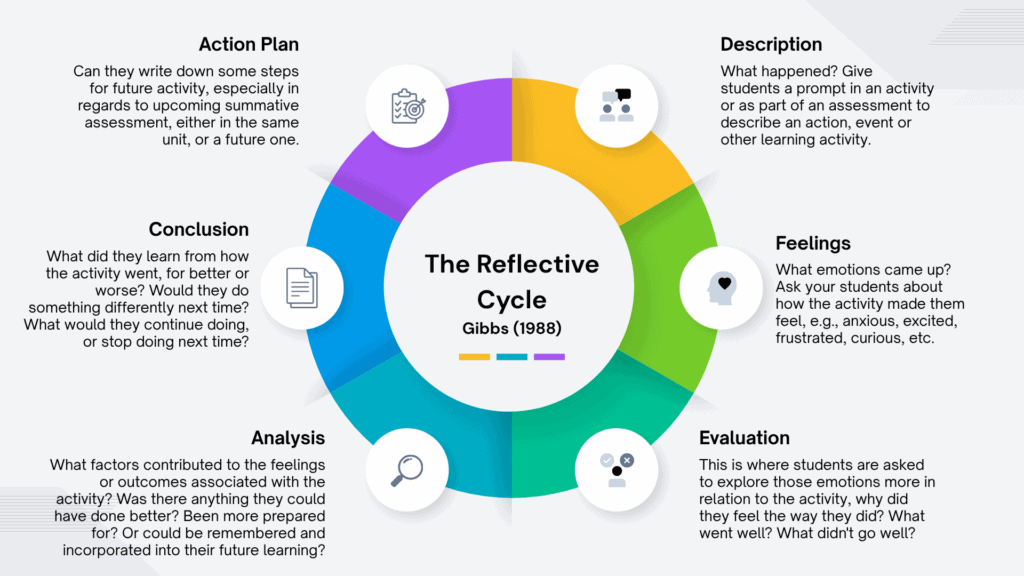
For students, a simpler version is nicely encapsulated with Rolfe (2001); What? So what? Now what?
Planning and implementing reflective learning for your students can be a complex and individual to your course/unit, please feel welcome to contact a member of the CLT to discuss options and to get support with designing something that will work for you and your context. Details to find us our at the bottom of the page.
At the Micro-level
Build reflection into relevant activities and give students an opportunity to practice thinking reflectively and produce reflective artefacts. The table below shows some suggested smaller activities:
| Teaching context | Suggested activity |
|---|---|
| Seminars | Ask students which idea challenged their thinking and why. |
| Group projects | Invite students to examine how their decisions affected collaboration and outcomes. |
| Laboratories or practical sessions | Ask students to compare expected and observed results and explain what they would investigate next. |
| Placements | Use anonymised experiences to explore relationships between theory, professional expectations and practice. |
| Assignment feedback | Ask students to identify a priority for improvement and explain how they will address it in their next task. |
Reflection can take the form of writing, discussion, audio or visual work. Choose a format that suits the learning purpose and students’ access needs.
How can reflection be assessed?
Reflective assessment may take various forms, such as a learning journal, portfolios, or reflections on projects, labs or placements, or a commentary on completed work. It is essential that reflection directly supports the intended learning outcomes, this helps students understand the purpose of the reflective exercise, and feel more motivated to participate.
Make expectations transparent. Depending on the task, assessment criteria might address:
- Analysis of relevant experiences
- Use of evidence and connections with disciplinary knowledge
- Consideration of assumptions and alternative interpretations
- Recognition of learning and development
- Specific, justified plans for future action
Reflection can be a powerful form of assessment, as it requires a student to conduct a very personal introspection on their learning and application. It benefits from being difficult to emulate by tools such as Generative AI in a meaningful manner, making it a useful tool for trying to gauge a students understanding of the subject.
Marking the process of learning, not just the output
You will want to offer students opportunities to practice the skill of reflecting, through formative tasks, feedback and opportunities to practice. You will also need to consider how you will intend to mark the work that the reflection is attached to. Reflections offers students the opportunity to be awarded marks on a project/assessment, by evaluating their decisions and process, and not just on the efficacy or ‘success’ of the output.
For example, students may be asked to produce a project output as part of a group, such as a business plan or a practical experiment. During the course of their project, they may struggle with group dynamics, or find that their plan or experiment did not have the outcome that they had expected. A reflective component of the summative assessment lets students evaluate events, demonstrate awareness of what happened, and propose a course of action were they to do it again. Understanding of the process, and evaluation of why some things worked or didn’t, let’s the student be awarded marks on their individual part of the process.
This is because with reflection, students are able to reflect on the process, and why things might not have gone the way they had anticipated and what they could have done differently, demonstrating a deep understanding of their learning, even where the “product” of their assessment, had not been up to standard they had perhaps intended.
Deciding on how to mark this type of assessment would need thorough consideration to marking criteria and things like actionable feedback. Members of the Curriculum and Academic Development team would be happy to speak to you about your context to help you plan assessments that have a reflective component (see bottom of this page for a link to contacting us.)
What are things to be aware of?
| Teaching context | Suggested interventions |
|---|---|
| Superficiality in reflection – not a genuine reflection, but a student understands how reflection works and writes/says what they think you want to hear or what will get them the best result. | – Use prompts that probe assumptions: “Why did you respond this way? What other interpretations are possible?” – Ask students to connect a specific experience with theory, evidence or feedback, and identify what they would change. |
| Over reflection – your students are assigned too many reflective assignments/activities that they become fatigued and disengaged with it. | – Build in reflection at meaningful points, with a clear purpose, rather than after every activity. – Keep tasks proportionate through short time or word limits, and allow students to choose which experiences warrant deeper reflection. |
| Unfamiliarity with reflection – your students have not reflected before or regularly in their educational experience, so lack the skills or understanding to do it well. | – Explain its purpose and model the process using an annotated example or a spoken demonstration. – Start with low-stakes, guided activities and provide formative feedback before assessing reflection. |
| Highly descriptive writing – your students are good at writing about what happened, but do not then link theory to application or show analytical, evaluative or critical skills. | – Structure prompts around “What? So what? Now what?”, keeping the account of events brief. – Use contrasting examples to help students identify the difference between describing an experience and analysing its significance. |
| Analysis paralysis – your students get too focused on questioning and analysing their experience that they struggle to make decisions or plan actions. | – Limit the focus to one incident or question and create soft time limits for the analysis. – End with one achievable action to try, then revisit what happened so students see reflection as supporting experimentation. |
| Generative AI – your students attempt to offload the reflection to a tool that emulates reflection but is shallow and lacking in detail. | – Clarify permitted AI use and why students’ own interpretation matters; where appropriate, use AI to pose questions or challenge assumptions. – Design reflection around specific decisions, feedback and evidence from students’ work, with brief dialogue to explore how their thinking developed. |
Published on: 06/10/2026 · Last updated on: 06/10/2026
Key guidance
Guides from the TEL team with practical suggestions for providing students with the tools and environment for effective reflective practice and assessment:
Creating reflective assessments in Moodle: which tool should you use?
Resources
- Successful Reflective Writing
- Making Human Learning Visible in a world of invisible AI
- Actionable Feedback
- Marking Criteria
Get help from the CLT
Getting started integrating reflection into your teaching approach or assessment can take careful planning, if you need help understanding where reflection can fit in your unit/course, how to scaffold reflection effectively then please do contact a member of the CAD team using the link below.
Additionally, if you need help with digital tools that support reflective learning, a member of the TEL team will be able to support you.