
Published on: 10/07/2026 · Last updated on: 10/07/2026
Overview
This case study explores the development of a digital escape room activity. Created in Xerte for postgraduate taught students in psychology, the activity was designed to replace an in-person escape room visit. Visits had become increasingly expensive and difficult to organise, and a digital version would need to retain the benefits of collaborative problem-solving and team bonding. Based around Rosenhan’s controversial study, ‘On Being Sane in Insane Places‘ (1973), the game asks students to work together to solve puzzles, navigate a simulated hospital environment, and eventually escape. The trial demonstrated the activity was engaging and encouraged teamwork. It provided a memorable way for students to encounter and discuss a significant psychological study. It also offered useful insights, for the TEL team, into the design, development and potential reuse of Xerte-based escape rooms in other subject areas.
Background context
The Escape Rooms in Education Showcase, run by Heriot-Watt University since 2023, inspired us to share examples of some Xerte based escape room games via the TEL Community of Practice Teams space in June 2025. Following this, Professor Richard Joiner from the Department of Psychology contacted TEL with an idea for a new activity.
The resulting game, St Elizabeth’s Asylum, was proposed by Richard and devised and created in consultation with Yvonne Moore, Digital Education Developments Lead, and Dr Eliana Cortes Paez, Instructional Designer, from the Technology Enhanced Learning team.
Richard’s aim was to create a digital escape room in which postgraduate students could work collaboratively to solve puzzles. The activity would replace an in-person visit to a commercial room. This had become costly to arrange and was sometimes logistically difficult for students to attend. The purpose of the digital version was to provide a team bonding exercise at the start of the course. There would be an additional benefit, of introducing students to Rosenhan’s ‘study, ‘On Being Sane in Insane Places’ (1973).
Opportunity
From the TEL team’s perspective, the project was also an opportunity to explore the process of designing a digital escape room, the resources required to create one, and the potential for adapting this approach for other disciplines.
- Xerte was selected as the development platform. It had already been used to create several educational escape rooms and includes features that support game-based learning activities. These included:
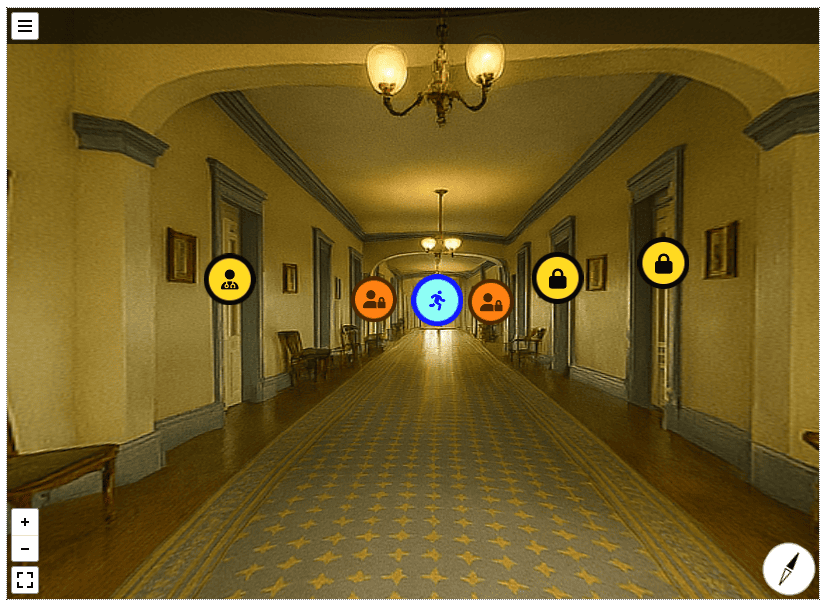
- 360° images, used to present rooms and corridors in the hospital, with clickable interactions and movement between scenes.
- Access codes, used to create locked spaces that could only be opened when the correct code was entered.
- Quiz and multiple-choice question pages, used for puzzle-based interactions.
- Dialogue pages, used to simulate conversations where students had to provide an answer before proceeding.
- Hotspots, used to create clickable areas within images and scenes.
Themes
The project addressed several learning and teaching themes:
- Assessment and feedback – in-game feedback supported students as they progressed through the tasks.
- Inclusion – the activity was designed around collaborative role-play and group problem-solving.
- Scaffolding – help and hints were embedded within the game to support progress.
- Student experience – the immersive game scenario aimed to increase engagement.
- Authentic tasks – the activity simulated aspects of the research study, albeit in a deliberately stylised and exaggerated way.
- Team building – the structure of the game required students to communicate, share information and work together.
Approach
Yvonne and Eliana met with Richard over seven meetings to discuss the game, its narrative, and the puzzles. Many in-person escape rooms are built around recognisable themes, such as detective mysteries, spy missions or bank heists. For this activity, the team wanted a theme that was directly connected to Psychology.
Richard suggested Rosenhan’s ‘On Being Sane in Insane Places’ because it has generated considerable debate and controversy since its publication. This gave the activity a strong disciplinary focus while also providing a rich context for role-play, mystery and discussion.
The team followed a staged design process:
- Building familiarity with the study – Copilot was used to help summarise themes from Rosenhan’s study and to generate ideas for the game’s backdrop.
- Developing the storyboard – the team created a storyboard that included:
- the overall task and narrative
- the roles students would adopt in the game
- the characters students would encounter, including doctors, nurses and patients
- the digital resources needed to create the game world
- possible pathways through the game
- the puzzle list and activities students would need to complete
- Creating a prototype in Xerte – the narrative and collected resources were built into an initial prototype.
- Testing and review – Richard and the wider TEL team tested the prototype. This identified areas that needed refinement.
- Finalising the game – the game was prepared for students to play.
- Gathering feedback – feedback and observations were collected from the trial activity to inform future improvements.
Development work
Once the theme and roles had been agreed, the development work focused on two main areas. We needed to create and source resources and build the learning object in Xerte.
360° images
To give the game an immersive feel 360° images allowed players to feel like they were moving around a building. Eliana created a set of 360° scenes to support this. This involved:
- using Copilot to rebuild a virtual copy of St. Elizabeth’s Hospital
- selecting key spaces using the original layout of the hospital
- training AI using black and white photos of the hospital sourced from the US National Archive
- using a series of images to recreate some spaces of the hospital
- using specific architectural details in prompting to achieve 360°, realistic images
- editing 360° images in Copilot to add/remove clues and create different scenes with a consistent visual style
Selecting Xerte page types
Xerte has an extensive range of page types and interactions so part of the development process involved testing the options that would best support puzzles and navigation.
As the number of interactions increased, the possible routes through the game became more complex. The team therefore needed to keep a flow chart of the different pathways to track how students could move through the activity. This was an important part of the development process, but it also highlighted a key consideration for anyone wanting to reuse or adapt the approach: digital escape rooms can become complex quickly, especially when they include branching pathways, multiple puzzles and locked sections.

The game in action
The game was trialled in person with two small teams. We used a different student cohort, but they still revealed how students interact with the activity.
Eliana introduced the game and then observed the students as they worked together. The students initially spent time deciphering the rules and agreeing a plan. Once they had established how to approach the task, the activity became a fun and collaborative exercise.
The topic and use of Rosenhan’s study were suitable for students, and the 360° images helped make the scenario feel more credible. This trial run also showed that some instructions could be strengthened, but the overall navigation worked well.
Students worked effectively as a team to solve the puzzles. One student commented:
“It was great and really fun. Thank you :)”
At this stage, the evidence of impact is mainly qualitative and observational, although we had feedback from three students via a survey. The trial showed that students were engaged and worked well together. They also strongly agreed that the images and videos created from the original St Elizabeth’s Asylum made the game feel more realistic and immersive, and that the vocabulary and terminology used were suitable for the context of the game.
Richard also enjoyed the development process, particularly the opportunity to incorporate the psychology element into the game. He felt that the activity was successful and met the learning objectives he had set out to achieve. It was pleased that students worked well together and enjoyed the experience and Richard would use the escape room with a future cohort and would like to develop a follow-up activity focused on reflection of Rosenhan’s controversial study, and its impact on the field.
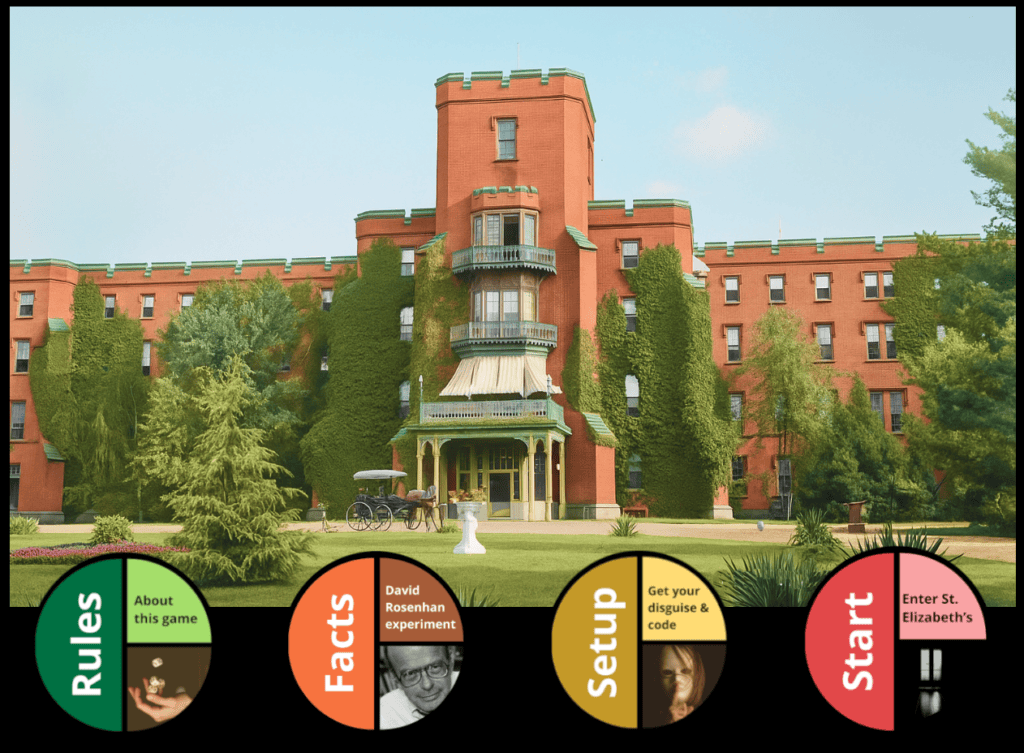
Summary of outcomes
The trial suggested that the digital escape room was a successful and engaging team bonding activity. It encouraged students to collaborate, discuss workable solutions, and make decisions together. The use of a game scenario helped create a sense of purpose and momentum, while the psychology theme ensured that the activity remained connected to the subject area.
The main benefits of this approach were:
- it provided a lower-cost and more flexible alternative to a commercial escape room visit;
- it enabled students to work together in a structured but playful way;
- it introduced a classic psychological study in an engaging format;
- it encouraged communication, problem-solving and decision-making;
- it allowed the TEL team to explore how Xerte could support immersive, scenario-based learning.
The activity also raised some practical considerations. Digital escape rooms can take time to design and build, particularly when they include branching pathways, custom imagery, narrative elements and multiple puzzle types. Clear instructions are essential, especially at the start of the activity, so students understand the rules, the goal and how to interact with the game.
Xerte analytics could also be reviewed, where available, to explore completion rates, time on task and any points where students struggled or became stuck.
Overall, this was a suitable approach because the intended learning experience was collaborative, exploratory and discussion-based. The digital escape room format provided a purposeful setting for students to interact with each other while engaging with disciplinary content.
Lessons learnt
For others interested in creating a similar activity, the main lesson is to invest time in planning before building. The game’s narrative, student roles, puzzle sequence and routes through the activity should be mapped out before development begins. A storyboard or flow chart is especially useful, as it helps keep track of the different pathways and dependencies between puzzles.
It is also important to keep the student experience simple and clear. Although complex branching can make a game feel more immersive, it can also make development, testing and reuse more difficult. Starting with a smaller prototype and testing it early can help identify problems before the structure becomes too complicated.
Feedback
The feedback showed that students found the activity engaging, immersive and fun, and that they worked well together to solve the puzzles. This suggests that the escape room format was well suited to the aim of supporting team bonding. However, the responses also highlighted the importance of balancing challenges and clarity. Students need enough complexity for the activity to feel like a genuine puzzle, but not so much that they become unsure about how to progress.
Clear instructions are particularly important at the start of the activity. Students need to understand the aim of the game, how to navigate, how to work together, and what to do if they get stuck. Built-in hints and feedback can help maintain momentum without removing the challenge.
The project also showed the value of collaboration between academic and TEL colleagues. Richard brought the disciplinary expertise and learning objectives, while the TEL team supported the learning design, interaction design and digital development. This combination helped ensure that the game was both pedagogically meaningful and technically achievable.
In future versions, the activity could be enhanced by:
- strengthening the opening instructions and orientation;
- adding a short debrief activity after the game;
- asking students to reflect on Rosenhan’s study and its ethical, methodological and historical significance;
- collecting more structured student feedback; reviewing analytics to identify where students spend most time or encounter difficulties;
- considering how the template could be adapted for other subject areas.

A useful next step would be to build reflection more explicitly into the activity. For example, after completing the escape room, students could discuss how the game represented the study, where it simplified or exaggerated events, and how Rosenhan’s work has influenced debates in Psychology.
Further reading and resources
- D. L. Rosenhan, Symposium, On Being Sane in Insane Places, 13 Santa Clara Lawyer 379 (1973). Available at: https://www.science.org/doi/10.1126/science.179.4070.250
- Escape Rooms in Education Showcase, Heriot-Watt University.
- Xerte guidance, documentation and examples of escape room-style learning objects.
- Try out St Elizabeth’s Hospital Escape Room Game
Copilot and ChatGPT were used to create some of the images in this article.