
Published on: 15/07/2024 · Last updated on: 04/09/2026
Introduction
Designing inclusive assessment means recognising that many challenges are shared across students, even if they are experienced more acutely by some. By identifying common patterns of difficulty and addressing them in the design stage, you can improve the experience for all students and reduce the need for individual adjustments.
This guide brings together two complementary approaches:
- Patterns Beyond Labels – to help you identify where barriers occur
- The 3Rs (Remove, Reduce, Rethink) – to help you decide what to do about them
Used together, they provide a simple, practical framework for inclusive assessment design.
1. Identify patterns of barriers (inclusion lenses)
Patterns Beyond Labels (PBL) is a strategy to creating a teaching and learning space that is inclusive and accessible to all students. PBL helps us rethink the narrative of inclusivity by looking beyond the stigma and shadow of a label and see that marginalised students do not experience distinctly different challenges than those of the wider student cohort, instead they often experience a more exaggerated version of the difficulties that all students face. Therefore, if we tailor our teaching and learning to meet the needs of marginalised students then all students will benefit.
You can identify patterns through:
- student feedback and cohort trends
- common issues raised in IMCs or DAPs
- your own observations of where students struggle
How can you apply it?
Patterns Beyond Labels works by identifying patterns in difficulty across three key areas or lenses of inclusion:
- Physical inclusion: this refers to the learning environment and access to learning. This could mean physical access or sensory access.
- Example: ramp access to buildings, timing of assessments, environmental factors in assessment space, inaccessible learning materials.
- Cultural inclusion: this refers to the content we teach and the examples we use. This can also refer to “Hidden Curriculum” or hidden rules that not everyone will have been introduced to or have access to.
- Example: cultural references or idioms, implicit academic conventions, unfamiliar assessment formats.
- Cognitive inclusion: this refers to how students assimilate, process, recall and synthesise knowledge.
- Example: heavy cognitive load, unclear instructions.
Can you spot the pattern?
Below are the name and profiles of 5 students. The students have different backgrounds, but can you spot a pattern in the challenges/barriers they may have?
2. Responding to barriers (the 3R’s: remove, reduce, rethink)
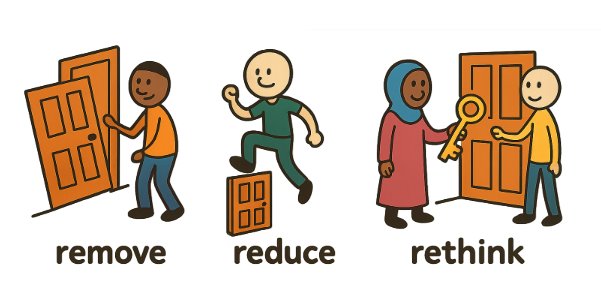
Applying these models in practice
The table below shows how common patterns can be addressed with the 3R’s
|
Pattern |
Barrier |
Remove |
Reduce |
Rethink |
|---|---|---|---|---|
|
Physical |
Fixed or demanding environment |
Remove constraints |
Offer flexibility in timing or access |
Provide alternative formats |
|
Cultural |
Hidden expectations |
Make criteria explicit |
Share exemplars |
Discuss standards and expectations with students |
|
Cognitive |
Unclear assessment brief |
Simplify instructions |
Provide examples and FAQs |
Break down task into stages |
Presentation
Example of barriers: Students may experience anxiety, unclear expectations, or difficulty managing multiple demands.
At the point of course/unit design and delivery consider the following in order to Remove, Reduce and/or Rethink potential barriers to assessment via presentations:
– Consider how the presentation needs to be delivered and whether students could pre-record presentations rather than present live. Could students present remotely or in a pair to reduce pressure on them individually?
– Presentation anxiety is very common amongst students. It can also be helpful to normalise that presentation anxiety is common and it does not necessarily undermine a student’s ability to present well.
– If students struggle with extreme nerves associated with presenting, they can practise building their confidence by becoming accustomed to using their voice in public. Encourage them to build this skill gradually over time by contributing in class/to small group discussions so they can work up to their presentation.
Group work
Examples of barriers: Anxiety over social and contributionary factors, uncertain group roles and scheduling, expectations over workload, check-ins and dynamics with others.
At the point of course/unit design and delivery consider the following in order to Remove, Reduce and/or Rethink potential barriers to assessment via group work:
– Provide options to enable group members to work on individual aspects of group work.
– Break down group assessment into specific activities with deadlines to reduce ambiguity and unequal contribution.
– Getting students to break down tasks in a way that is manageable, realistic and sustainable can also better equip students to work effectively in teams. Encourage them to also review progress as a team so they can see distance travelled.
– Encourage students to produce a contract which is realistic and supports the members of the group to achieve its aims. Whilst a contract can encourage greater fairness, building in a degree of flexibility will help students to set realistic goals and expectations.
Practical Assessments & Labs
Examples of barriers: Expectations of lab safety and behaviours, unfamiliarity with practical components, access to physical spaces, unclear instructions.
At the point of course/unit design and delivery consider the following in order to Remove, Reduce and/or Rethink potential barriers to assessment via practical assessments and labs:
– Reduce overwhelming lab environment – an overwhelming environment can often lead to attendance difficulties for many students. Can some students arrive an agreed few minutes early to settle prior to the majority of the class arriving at once?
– Lab access – can labs practically be open for extra sessions/different hours to enable students who maybe struggle to complete the work in the set time finish work?
– Lab partners – for example – encourage and facilitate group/pair work, it may be helpful to provide opportunities for pairs to meet in advance of lab sessions (pre-labs) to ensure both have an understanding of task, can familiarise with activity out of time pressured lab session.
Exams
Example barriers: access to physical spaces and times, anxiety over timebound component of examinations, environmental discomfort.
At the point of course/unit design and delivery consider the following in order to Remove, Reduce and/or Rethink potential barriers to assessment via exams:
Consider Q&A session after trial runs or mock exams to allow for clarification. Record and make accessible for students to revisit.
– For 24 or 48 hour exams, clearly outline expected duration of the exam to prevent misuse of time management.
– In the case of in-person exams, when and where possible, consider the impact the exam environment may have on student performance (size of room, temperature, noise levels, etc.) and reduce as many barriers as possible.
– Whilst it is not always possible to create the ideal assessment environment for all students, encourage students to make small changes in terms of how they might adapt their environment. e.g. using assistive software, altering text size and colour background.
Written Assessments
Example barriers: time pressure, unfamiliar to assessment type, expectations.
At the point of course/unit design and delivery consider the following in order to Remove, Reduce and/or Rethink potential barriers to assessment via written assessments:
– To reduce individual emails and consolidate similar queries, create an online forum or a session for students to ask specific questions related to the assignment or exam. Make this accessible for students to revisit later. Students will also benefit from knowing what other students have asked.
– Carry out a ‘sense check’ by sharing assignment briefs with a colleague to ensure instructions are clear and accessible.
– In the case of in-person exams, when and where possible, consider the impact the exam environment may have on student performance (size of room, temperature, noise levels, etc.) and reduce as many barriers as possible.
– For some activities or when students are new to the course, consider breaking down briefs (or encourage students to do this) into specific, smaller deadlines tasks/subheadings/activities to make it easier to learn the skill of managing deadlines.
Key principles
- Design for patterns, not labels: focus on common challenges rather than individual categories of students.
- Address barriers early: build inclusivity into the design stage rather than retrofitting adjustments
- Align with learning outcomes: only retain barriers that are essential to what you are assessing
- Use a mix of approaches: removing, reducing and rethinking barriers work best in combination
You can use the prompts in this workflow to assist your approach:
- Identify where students commonly struggle
- Map these challenges to physical, cultural or cognitive patterns
- Decide whether to remove, reduce, or rethink each barrier
- Make changes at the design stage
- Review and refine based on student experience
Other considerations
In addition to the suggestions above, you may have contact with students who would benefit from further individualised adjustments or professional support in relation to their disability, wellbeing or mental health management.
Students can access support through the Wellbeing, Mental Health and Therapeutic Services within Student Support and Safeguarding. Staff should direct students to contact the Wellbeing team if the wellbeing and welfare of a student is being impacted. For students wishing to explore practical support for long-term conditions, staff should encourage contact with the Disability Service so that individualised adjustments can be discussed.
For staff looking for extra advice on how to support students please visit the Student Support advice for Staff page or call 01225 384321 or extension 4321.